

Nesting is a decorative molding method that nests two or more glasses (such as colorless glass, colored glass, colorless glass, colored glass, and milky glass). When multiple colors are used, the expansion coefficients must match each other, otherwise the product will burst. When designing the glass formula, the expansion coefficients are calculated to match them. Due to the influence of raw material composition, melting temperature, and volatility, the expansion coefficients of various color materials may change. They can be produced within the range of ±3×10⁷℃¹. The expansion meter or the press matching method can determine whether the linear expansion coefficients match. If these two detection methods are used after production, when the problem is found, the damage has already occurred and the loss is huge. If used before production, the test sample must be annealed for several hours before judgment. Especially when producing colored glass, it is difficult to wait so much time in actual operation. In this case, there is an urgent need for a test method that can play a warning role before production, and the double wire method has such a role. The double wire method is to fuse two pieces of glass and draw them into a wire shape to form a bimetallic system.
Measurement method: Some materials suggest using a blowtorch and wire drawing pliers to make the glass to be tested into a flat spatula shape. Here is a simpler and more practical method that does not require the use of wire drawing pliers.
The glass to be tested and the standard glass with known linear expansion coefficient are made into glass rods with a length of 200-400mm and a diameter of 1-3mm. Overlap the two glass rods at the joint with an overlap of 5-10mm. Fuse the two glass rods together with the help of a blowtorch flame. Remove the flame during the softening of the glass and immediately pull the glass to parallel on both sides without deflection or rotation. Pull the glass rod into a double wire with a length of 400-800mm and a diameter of 0.1-0.3mm and cut it in the middle. When the linear expansion coefficients of the two glasses are the same, the double wire will be straight after cooling; otherwise, the double wire will be bent. Compare the linear expansion coefficients of the two glasses by the chord length and chord height when the glass wire is bent.Measurement method: Some materials suggest that the glass to be tested needs to be made into a flat shovel with a blowtorch and drawing pliers. Here is a simpler and more practical method: you don’t need to use drawing pliers.
The glass to be tested and the standard glass with known linear expansion coefficient are made into glass rods with a length of 200-400mm and a diameter of 1-3mm. The two glass rods are overlapped at the joints with an overlap of 5-10mm. The two glass rods are melted together with the help of a blowtorch flame, as shown in Figure 4-17 (a) and (b). The flame is removed while the glass is softening, and the glass is immediately pulled parallel to both sides without deflection or rotation. The glass rods are pulled into double wires with a length of 400-800mm and a diameter of 0.1-0.3mm. The wires are then cut from the middle. When the linear expansion coefficients of the two glasses are the same, the double wire is a straight line after cooling; otherwise, the double wire will bend. The linear expansion coefficients of the two glasses are compared based on the chord length and chord height of the glass wire when bent.

Determination of linear expansion coefficient by double wire method
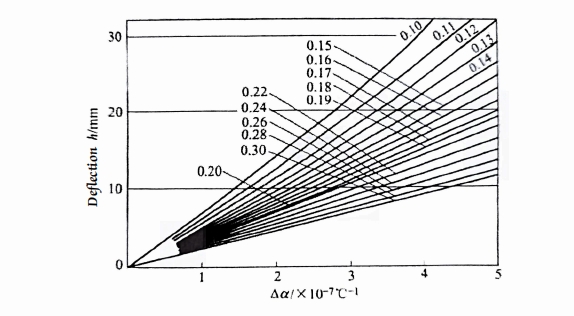
When the glass on the wire side is bent, the linear expansion coefficient of the glass on this side is larger. The curvature of the double wire becomes proportional to the thickness of the wire and inversely proportional to the difference in linear expansion coefficients of the two glasses.
Use a micrometer to measure the thickness of the double wire bending plane. Measure the thickness at the center of the wire and 50mm away from both ends of the wire, take the average value, and its size should be between 0.1 and 0.3mm. If the thickness difference exceeds 0.02mm, the wire is unqualified.
Use a mirror ruler to measure the deflection h of the double wire with a chord length of 200mm (as shown in the figure). Place the double wire on a 250mm×300mm glass plate, and adjust the wired glass plate (200mm×250mm) according to the mirror index plate until the wire in the mirror coincides with the 200mm long chord end. When moving the wired glass plate, you must ensure that the wire is perpendicular to the glass surface so that the reflection of the wire can be seen in the mirror.
Suppose it is to check whether the linear expansion coefficients of different colour materials in production match. In that case, it is generally used to take a clear glass rod as a standard rod, take a matching colour glass rod, overlap the two glass rods, and weld them on the flame of a blowtorch. Leave the flame before melting, pull the two rods flat in two opposite directions, and pull the welded part into a filament with a 0.1-0.3mm thickness.
Cut the filament from the middle. If the filament is straight, the two glass materials match. If the filament is bent, the bending degree can be used to judge whether the two glass materials are usable. Draw a ruler on the glass plate or other flat surface. The ruler length is 200mm, and the two sides of the centre are 100mm each. Hold the glass rod to overlap the bent glass filament with the two ends of the ruler, and measure the bending height. When the bending height between the general soda-lime glass explicit material and the colour glass material is less than 5mm, the two materials will not burst when used together. Otherwise, the glass products will still be damaged no matter how long the annealing time is. The bending height between the explicit material and the opal porcelain material is more variable, and the maximum limit varies according to the glass composition and annealing temperature. This needs to be determined by the manufacturer according to the glass composition, and the maximum limit is determined by the double-wire method.
When the linear expansion coefficient of the transparent material changes by the double wire method, it can be inferred that the composition of the explicit material fluctuates. Many samples of the transparent material rods are kept as standard rods at a particular time. After that, samples are taken daily or at intervals for matching tests with the standard rods to check whether the expansion coefficient of the transparent material changes.
They take the explicit material and the colour material on the day of production and use the double wire method to determine whether the two materials match, which has excellent guiding significance for production. If the two materials do not match, the production department can be notified to stop using this colour material before production to prevent losses.


